On the morning of March 30–31, 2026, four stories landed in a single retail industry newsletter. None of them were about building products. None of them were about HVAC or plumbing or kitchen and bath. None of them mentioned contractors, dealers, or spec writers.
But if you read them together — not as retail news, but as signal — they form one of the clearest pictures of the B2B demand environment I’ve seen in a single day’s feed in years.
That’s the argument I want to make here. Not about the stories themselves, but about the method.
Four Stories, One Morning
The stories were these:
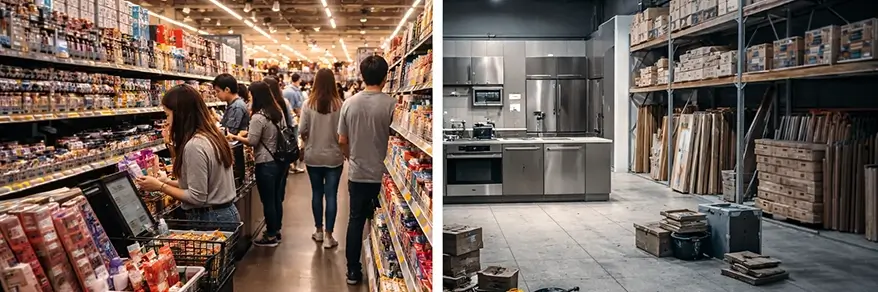
Circana reported that total U.S. retail sales revenue was up 2% for the first ten weeks of 2026. That sounds healthy until you read which categories were driving it: video games, beauty, auto aftermarket, food and beverage, fashion accessories. The growth narrative was built entirely around what Circana calls “lifestyle spending” — feel-good purchases grounded in passion and habit. Hard goods for the home were not in the picture.
Sysco, the nation’s largest foodservice distributor, announced a $29.1 billion acquisition of Jetro Restaurant Depot, the leading cash-and-carry wholesaler serving small independent restaurants. The stated logic: enter a “higher-margin, growing, and resilient” channel. Translation: Sysco’s traditional broadline delivery model needed a hedge, and they paid a significant premium to get one.
McCormick & Company announced a $44.8 billion combination with Unilever’s foods division — Hellmann’s, Knorr, Marmite, and dozens of other global brands. McCormick’s CEO described it as a bet on flavor. What the deal quietly acknowledged is that Unilever’s food sales fell 3% in 2024 as consumers shifted to store brands and less processed options. McCormick is acquiring distressed scale at a moment when flavor and condiments are two of the few categories holding up in the Circana data.
And Quinnipiac University released a national poll on AI attitudes. Seventy percent of Americans believe AI will lead to a decrease in job opportunities. Fifty-five percent say AI will do more harm than good in their daily lives — up eleven percentage points in a single year. Use of AI tools is rising sharply, but trust is not moving at all: only 21% trust AI-generated information most of the time.
Individually, each story fits neatly into its own vertical. Retail analytics. M&A. Tech sentiment. Separately, they generate separate press releases and separate newsletter mentions that people read and move on from.
Together, however, they are something else.
The Pattern Underneath
What these four stories share is a common substrate: a consumer — and a business customer — under simultaneous, multiplying pressures, making defensive choices about where to spend and where to hold back.
The Circana data confirms spending is continuing, but it’s bifurcating. Consumers are spending on small pleasures, habit-based replenishment, and emotional comfort — the categories with low price points, high frequency, and the psychological relief of feeling good in an anxious moment. They are not spending on the large, considered, capital-intensive purchases that require optimism about the future. Faucets, HVAC upgrades, kitchen renovations, plumbing remodels — these sit on the wrong side of that bifurcation.
The Sysco deal frames what rational companies do when they see this pattern holding. They buy channel resilience. Cash-and-carry is a format that thrives precisely when the customers it serves are watching costs. Small, independent restaurant operators don’t call a sales rep — they show up, put things in a cart, and pay cash. That format removes friction and margin from the distribution layer, and that is what operators want when their own margins are squeezed. Sysco spent $29 billion to own that relationship.
McCormick’s move is a different kind of rationality. They looked at Unilever’s food portfolio — a set of brands with enormous global recognition and declining sales — and decided the underlying assets were worth more than the current trajectory suggested, provided you could attach them to a company with the operational focus to run them properly. The strategy is consolidation as defense: own enough of the category’s demand infrastructure that even a shrinking overall market doesn’t shrink you. In B2B terms, this is the manufacturer equivalent of capturing the spec.
And the AI poll? That’s the deepest signal of the four, and the easiest to misread as unrelated.
 Workforce displacement anxiety is not a technology story. It’s a deferral story. When 70% of people believe the jobs landscape is about to shift under their feet, they do not make large financial commitments. They don’t pull permits. They don’t sign contracts. They don’t replace perfectly functional HVAC systems or undertake kitchen renovations that require two to four weeks of disruption. They wait. The Quinnipiac data is telling us that a significant share of the consumer market is in a psychological holding pattern — not broke, not collapsing, but not buying the things that require confidence about next year.
Why Retail News is B2B Intelligence
I’ve been reading the Business of Fashion for years as a forward indicator for building products and interiors. It sounds counterintuitive until you understand what fashion actually measures: how willing people are to project confidence about who they’re about to become. Fashion is an optimism trade. When consumers stop buying aspirational clothing — trading down to basics, buying less, reaching for what they own — the renovation cycle follows that psychology with a lag of six to eighteen months.
RetailWire functions differently. It’s more synchronized than leading. But what it offers that most B2B-focused trade publications don’t is visibility into the demand economics of physical goods moving through distribution — the friction, the margin, the channel behavior. When the two biggest actors in a single supply chain vertical both make nine-figure bets on the same morning, something is being priced into the market. The signal is in the structure of what they bought, not the headline valuation.
Sysco bought channel control over cost-sensitive buyers. McCormick bought category dominance at a moment of concentrated distress. Both moves reflect the same underlying read: the next phase of competition in physical goods distribution rewards those who own the relationship with the buyer and own enough of the category to absorb softness in any single segment. Scale and channel lock-in are the moats.
This isn’t a distribution problem. It’s a toll booth.
This underlying current is not new, of course. In B2B building products, it has been running for decades. Manufacturers have always been structurally at the mercy of distributors, who controlled access to the contractors. And contractors controlled the relationship with the end user — the homeowner, the building owner, the facilities director — the ultimate buyer, because they are the ones with the money and the authority to commit it. Manufacturers have been trying to find a path around that insulation for as long as there have been trade shows and co-op advertising programs. Direct-to-consumer campaigns. Architect and designer outreach. Brand specification programs. Some of it worked at the margins. None of it resolved the structural problem. The distributor remained the gatekeeper.
What the Sysco and McCormick moves suggest is that the consolidation now underway may finally be large enough — and fast enough — to change that geometry. When distribution platforms achieve the scale and channel diversity that Sysco is buying, and when brand portfolios achieve the category dominance that McCormick is assembling, the manufacturer who has built a genuine presence with the end user suddenly has a different kind of leverage. The platform needs the brand. The brand needs the platform. That’s a negotiation. What manufacturers in building products have faced for most of their history isn’t a negotiation — it’s a toll booth.
For manufacturers in building products, HVAC, plumbing, and kitchen and bath, the translation is direct: your channel relationships are being repriced right now, whether you’re at the table or not. The distributors and buying groups who serve your customers are watching the same economics Sysco saw and drawing the same conclusions. Consolidation accelerates. Smaller players lose access. The spec gets written by whoever is present when the decision is made.

The Question This Leaves for Your Business
Here is what I’d ask any B2B marketing or strategy leader to sit with after reading these four stories together.
If your demand environment is bifurcating — small, habitual, feel-good purchases holding up, large capital-intensive purchases softening — where does your product sit? And is your marketing positioned to speak to buyers who are deferring, or only to buyers who are ready to commit?
If the smart money is buying channel control and category scale, what does that mean for your own distribution relationships? Are you the brand that gets pulled through by a consolidating distributor, or the one that gets rationalized out of the assortment when margin pressure arrives?
And if 70% of the workforce believes AI is about to change the employment landscape — if that anxiety is sitting underneath every large financial decision your end user is about to make — are you building the kind of brand presence that earns the benefit of the doubt when hesitant buyers finally decide to move?
None of these questions came from a construction forecast or a housing start report. They came from a retail newsletter that didn’t draw any conclusions.
That’s the point.
A Note on Method
The intelligence value in retail and consumer media for B2B marketers isn’t in the stories themselves — it’s in the synthesis. Individual headlines are noise. The pattern across multiple signals from different sectors on the same day is closer to something you can act on.
Interline has been reading the market this way for clients in building products, HVAC, plumbing, and related sectors for thirty years. We look at what the broader consumer economy is doing not because our clients sell to consumers — many don’t — but because the consumer sets the context in which every B2B purchase decision eventually gets made. Contractors, engineers, designers, and facilities managers all live in the same anxious economy the Quinnipiac poll is measuring.
The headlines change. The method doesn’t.
_____________________________________________
Works Consulted
Circana. “Consumer Passions and Priorities Give Lifestyle Spending New Significance.” March 2026. circana.com
Sysco Corporation. “Sysco to Acquire Jetro Restaurant Depot to Expand into Higher-Margin, Growing, and Resilient Cash & Carry Channel.” Press release, March 30, 2026. investors.sysco.com
McCormick & Company / Unilever PLC. “McCormick to Combine with Unilever’s Foods Business, Creating a Preeminent Global Flavor-Focused Company.” Press release, March 31, 2026. ir.mccormick.com
Quinnipiac University Poll. “The Age of Artificial Intelligence: Americans’ AI Use Increases While Views On It Sour.” Release #3955, March 30, 2026. poll.qu.edu